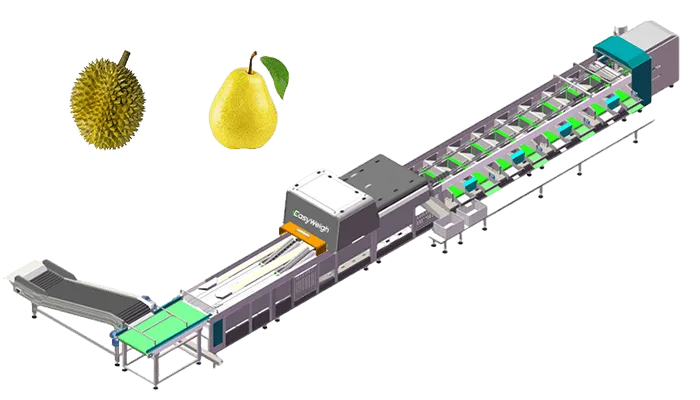
Traditional rule-based sorting logic relies on rigid color and size thresholds that frequently fail when grading irregular agricultural produce. Hardcoded algorithms cannot account for overlapping biological variances, leading to high rates of false misclassifications on packing lines.
Deploying a precision fruit sorting machine requires moving beyond fixed mathematical boundaries into adaptive computational models. Artificial intelligence resolves this fundamental precision deficit by replacing rigid rules with multi-variable probabilistic learning. Understanding the computational mechanics behind neural learning reveals why modern automation achieves unprecedented sorting accuracy.
Overcoming Rigid Rule-Based Limits Through Non-Linear Modeling
Legacy inspection software depends on linear threshold equations that treat agricultural grading as a simple binary decision process. Natural produce exhibits continuous color gradients, overlapping shapes, and complex surface textures that defy linear mathematical boundaries. Traditional systems constantly trigger false rejections because they lack the capacity to process non-linear biological relationships.
Artificial intelligence introduces multi-layered neural networks capable of mapping complex, multi-dimensional feature spaces simultaneously. High-dimensional mathematical mapping allows a fruit sorting machine to separate borderline specimens with microscopic precision. Neural nodes compute weighted sums and apply non-linear activation functions to capture subtle nuances that linear formulas completely miss.
Network backpropagation continuously optimizes internal connection weights by minimizing error rates across massive labeled training datasets. This rigorous optimization process ensures that classification boundaries bend dynamically around irregular organic shapes. Eliminating rigid linear constraints drastically reduces both false positives and false negatives during active production runs.
High-Dimensional Feature Extraction and Pixel-Level Pattern Learning
Convolutional neural architectures transform raw camera pixels into abstract feature representations that isolate microscopic skin defects effortlessly. Manual programming cannot anticipate every possible combination of blemishes, bruising, or irregular coloration found in seasonal harvests. Deep learning algorithms overcome this limitation by extracting hierarchical patterns directly from massive training datasets autonomously.
Early network layers detect simple edges, corners, and primary color contrasts across the surface of the moving item. Deeper hidden layers combine these basic elements to recognize complex shapes, textural degradation, and early-stage rot formations. Every training iteration refines internal weights, enabling the system to recognize subtle structural anomalies invisible to standard filters.
Pixel-level feature extraction ensures that minor surface blemishes no longer escape detection during rapid processing runs. Autonomous pattern learning eliminates human bias during algorithm development, establishing objective and repeatable inspection criteria across facilities. Advanced feature maps empower the core processor to distinguish between harmless dust and genuine surface contamination instantly.
Dynamic Adaptation to Shifting Environmental and Harvest Variables
Agricultural yields fluctuate wildly due to unexpected weather shifts, soil chemistry variations, and different regional growing conditions. Static algorithms require constant manual recalibration by technicians to prevent catastrophic drops in sorting accuracy across new harvest batches. Machine learning models solve this operational vulnerability through continuous adaptive learning loops integrated into the core software.
Advanced algorithms update internal decision boundaries automatically as fresh produce profiles pass beneath high-speed camera arrays. Maintaining peak precision enables a fruit sorting machine to adapt fluidly without requiring constant operator intervention. Environmental lighting shifts and ambient temperature variations are compensated for dynamically by background normalization layers.
Easyweigh incorporates adaptive intelligence frameworks that maintain pinpoint classification accuracy despite volatile raw material inputs. Continuous self-calibration minimizes downtime, ensuring that sorting facilities maintain strict quality standards throughout intensive, multi-shift production campaigns.
Resolving Edge-Case Ambiguities via Probability Distribution
Borderline agricultural items frequently hover right on the threshold between premium commercial grades and standard industrial processing tiers. Rigid algorithms make binary pass-fail choices that cause massive financial losses through accidental giveaway or misdirected premium stock. Probabilistic neural inference calculates a continuous confidence score for every single item instead of enforcing absolute binary limits.
Calculated probability distributions allow operators to fine-tune economic recovery targets based on real-time market pricing demands. Decision boundaries shift intelligently based on real-time market grade requirements programmed into the central control unit. Weight Sorting modules complement this probabilistic visual analysis by verifying mass distributions to eliminate remaining classification ambiguities.
Mathematical confidence scoring eliminates the erratic categorization swings characteristic of legacy rule-based threshold software. Every classification decision represents an optimized statistical evaluation rather than a rigid, brittle software condition.
Sustaining Precision Under High-Speed Industrial Constraints
Advanced neural computations demand immense processing power to maintain sub-millisecond evaluation speeds across heavy factory production lines. Graphical processing units execute parallel matrix operations instantly, preventing computational bottlenecks from degrading active sorting precision.
Easyweigh deploys high-performance hardware accelerators that process gigabit camera streams without introducing processing lag or timing errors. Precise synchronization between neural inference outputs and mechanical diversion hardware guarantees flawless physical interception of targets.
Integrating Weight Sorting data streams alongside neural vision parameters ensures comprehensive quality verification without compromising operational speed. High-speed parallel execution guarantees that complex deep learning calculations never impede active factory throughput requirements.
Engineering the Future of Precision Agriculture
Architectural integration of artificial intelligence represents a permanent leap forward in automated agricultural separation technology. Modern facilities no longer need to accept the inherent limitations of human fatigue or rigid rule-based software algorithms.
Easyweigh designs advanced automation systems where neural intelligence and Weight Sorting precision unite to redefine industry standards. Precision engineering transforms complex algorithmic theory into reliable, high-yield commercial reality for global producers.