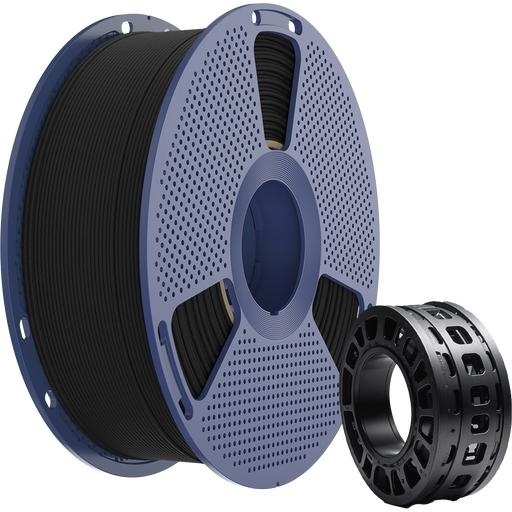
Choosing between PA-CF and PLA-CF depends on what a printed part needs to withstand. When comparing carbon fiber 3D printer filament options, consider mechanical strength, heat resistance, printing requirements, and the intended application.
PA-CF, which combines nylon with carbon fiber, is suited to demanding engineering applications requiring high strength and heat resistance. PLA-CF offers a more accessible printing process for rigid functional parts, prototypes, and models operating at lower temperatures.
Comparing material properties, printer requirements, and intended use helps narrow the options.
How Do PA-CF and PLA-CF Differ?
The main difference lies in the polymer base. PA-CF uses polyamide, commonly called nylon, while PLA-CF uses polylactic acid (PLA). Carbon fiber reinforcement can increase stiffness and influence dimensional behavior, but the underlying polymer still affects heat response, moisture sensitivity, and printing conditions.
The featured PA-CF filament contains 20% carbon fiber, while SUNLU PLA-CF contains 15%. These percentages provide useful context, but a higher fiber content does not automatically make a material suitable for every application.
The polymer type and measured properties also matter when selecting a pa cf filament for functional components.
Which Material Offers Greater Strength and Heat Resistance?
There is a substantial difference between these two materials. PA-CF has higher listed tensile strength, flexural strength, and heat deflection temperature (HDT), making it a candidate for parts exposed to greater mechanical loads or elevated temperatures.
| Property | PA6-CF | PLA-CF |
| Carbon fiber content | 20% | 15% |
| Tensile strength | 112 ± 10 MPa | 44 ± 5 MPa |
| Flexural strength | 192 ± 20 MPa | 79 ± 5 MPa |
| Heat deflection temperature | 203 ± 3°C | 55.5 ± 3°C |
| Density | 1.12 g/cm³ | 1.23 g/cm³ |
Values are supplier-listed specifications.
HDT indicates when a test specimen deforms under a specified load; it is not a recommended continuous operating temperature. Real-world performance depends on geometry, print orientation, layer bonding, and environmental conditions. Use the table for initial comparison, then validate critical parts through application-specific testing.
What Printing Requirements Should You Consider?
Printer compatibility can influence the practical cost and complexity of a project. PLA-CF uses a lower nozzle-temperature range, while PA-CF requires higher temperatures and more attention to filament preparation.
| Printing setting | PA6-CF | PLA-CF |
| Nozzle temperature | 270–290°C | 215–225°C or 225–245°C |
| Printing speed | 50–100 mm/s | 50–200 mm/s |
| Bed temperature | 50–70°C | 50–60°C |
| Drying considerations | 80–110°C | 50°C |
PLA-CF may suit users whose equipment supports conventional PLA printing temperatures. PA-CF requires a printer capable of reaching its specified nozzle temperature.
Both materials contain abrasive carbon fibers, so a wear-resistant nozzle is worth considering. Check the printer manufacturer’s temperature limits before selecting a filament.
Moisture management is particularly important for nylon. PA6-CF should be dried according to its product guidance and stored sealed with desiccant.
Wet filament can contribute to inconsistent extrusion and surface defects, complicating comparisons between materials. Keeping preparation and printing conditions consistent makes prototype results more meaningful.
When Is PA-CF a Better Fit?
PA-CF is worth evaluating for functional components exposed to mechanical stress or higher temperatures. Potential applications include gears, structural supports, tool accessories, and selected housings. Its higher listed tensile and flexural strength make it relevant when stiffness and load-bearing performance are priorities.
However, material strength does not replace sound design. Thin sections, sharp corners, screw holes, and layer orientation can affect failure behavior. Parts used in machinery or other demanding environments should be tested under representative loads and temperatures before being put into service.
When Does PLA-CF Make More Sense?
PLA-CF is a practical candidate for rigid prototypes, display models, lightweight fixtures, and functional parts operating in relatively mild thermal conditions. Its lower printing-temperature requirements may simplify setup for compatible desktop printers.
The carbon fiber reinforcement also provides a matte appearance that can suit models where surface texture matters.
Its lower listed HDT means it deserves careful consideration for parts left in hot vehicles, near heat sources, or in warm operating environments. PLA-CF may be suitable for a prototype that checks shape and assembly, but the same material may not meet the demands of a final component exposed to sustained heat or heavy loading.
How Can You Choose the Right Carbon Fiber Filament?
Start with the part’s operating temperature, mechanical load, dimensional requirements, and printer capabilities. For demanding engineering components, PA-CF offers stronger published mechanical values and a much higher HDT. For models and rigid parts with moderate performance requirements, PLA-CF can provide a simpler printing route.
A reliable selection process includes checking the technical data, printing a representative sample, and evaluating dimensions and performance under realistic conditions.
SUNLU provides specifications and recommended printing ranges for its PA6-CF filament, giving users a starting point for evaluating whether the material matches their project requirements.