“Catalyst” covers devices that may have little in common beyond the fact that they accelerate a reaction. A diesel SCR unit treats a moving exhaust stream to reduce nitrogen oxides. A catalyst in hydrogenation operates in an industrial process that adds hydrogen to feed components or removes unwanted elements. Different reactants, phases, and equipment create different specification priorities.
Comparing the two begins with the process boundary rather than the seller’s product catalog. The SCR diesel engine side needs exhaust temperature, NOx composition, reductant supply, flow, and allowable backpressure.
A catalyst in hydrogenation needs feed composition, hydrogen availability, reactor conditions, target products, and handling requirements. Missing inputs leave reactions and equipment limits unresolved.
Diesel SCR Uses a Coated Flow Path
The SCR unit’s chemistry depends on ammonia from the dosed reductant reaching NOx at active sites within the coated honeycomb. Exhaust must pass through a structure that exposes it to the coating without imposing unacceptable pressure loss. The geometry also has to withstand thermal changes and vibration in the vehicle’s exhaust line.
An SCR diesel engine may move through cold, moderate, and high-load operation in one trip. Temperature and the NO/NO₂ ratio can change the available reaction pathway, while dosing control determines ammonia supply. A part that works well at a steady test point must still be assessed during transients. Conversion and pressure should be measured in the installed configuration.
The substrate’s mechanical task follows from that setting. It is a fixed flow path subject to exhaust pulsation, heat shock, and vehicle vibration. Its relevant physical measures include channel geometry, cell density, pressure drop, and structural integrity after exposure. Those quantities say little about how an industrial packed bed will survive continuous handling and reactor service.
Hydrogenation Uses a Different Active System
A catalyst in hydrogenation meets a feed and hydrogen under conditions set by a process reactor. Depending on the duty, reactions can remove sulfur or nitrogen, saturate aromatics, or refine a product stream. Performance depends on the feed, hydrogen partial pressure, temperature, contact pattern, and desired conversion or selectivity. An exhaust NOx percentage is not a comparable metric.
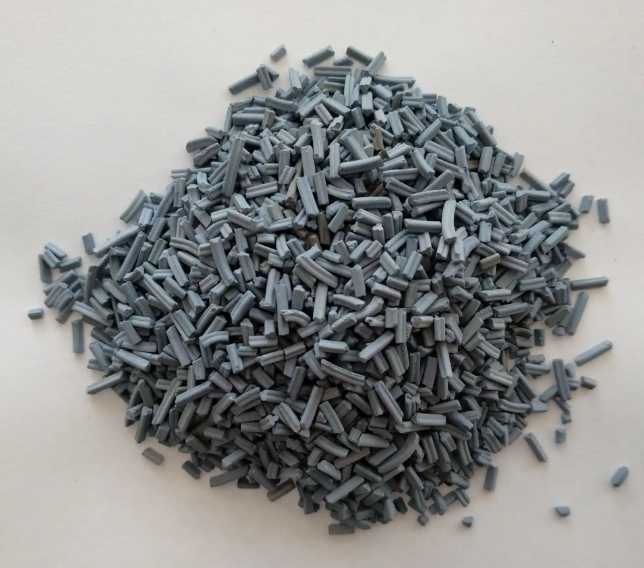
Hualian Catalyst‘s industrial hydrogenation product uses promoted alumina as a carrier for nickel and other metal components. The company names HDS, HDN, aromatics saturation, hydrofining, and other hydrogenation duties. The carrier and active metals are identified for that process family; they are not a diesel SCR washcoat merely because both products are called catalysts.
Mechanical demands also differ. A packed-bed material must tolerate compression and particle wear while allowing process fluids through the bed. Hualian describes its hydrogenation catalyst as designed for compression and attrition resistance. These properties matter because fractured particles and fines can change flow distribution and pressure behavior inside the reactor.
The hydrogenation product is described as reusable after regeneration. That statement concerns recovery of useful activity under suitable conditions, not indefinite life or a fixed number of reuse cycles. The reason for deactivation, physical condition of the particles, and measured activity after treatment all affect a reuse decision. Diesel SCR aging follows a different operating and maintenance history.
Reactor loading makes particle quality practical. Cylinders settle into a bed, and their dimensions influence void space and contact with the feed. Broken pieces or fines may create uneven flow before activity is exhausted.
The operator therefore monitors both reaction results and bed pressure behavior. A replacement or regeneration decision needs evidence from the feed and service history, not the word “reusable” on a product page.
Match Evidence to the Reactor or Engine
A comparison between these families pairs each product with its own duty and test. For diesel SCR, the record includes NOx conversion, ammonia control, exhaust temperature, pressure drop, and substrate durability. For hydrogenation, it includes feed-specific conversion or selectivity, reactor conditions, particle strength, and activity after regeneration where relevant.
Some words appear in both files: activity, pressure, temperature, and durability. Their measurement basis changes with the process. Pressure drop across a honeycomb is not the same installation problem as pressure through a packed bed. “High temperature” has no useful comparative meaning until the operating medium and reaction are named.
The active formulation is chosen for the temperature and gas composition the engine actually delivers. Different exhaust-temperature windows are addressed by vanadium-based, Cu-zeolite, Fe-zeolite, and Mn-containing options in Hualian’s honeycomb-based diesel SCR system. That range of choices does not imply that all four formulations are interchangeable at one temperature or on one engine.
Procurement therefore starts by identifying the reaction, phase, reactor geometry, service conditions, and acceptance test. The supplier can then match an active system and support form to that description. A catalog listing both families does not establish one universal catalyst specification. The application defines which numbers count.
For an industrial and vehicle program, separate technical files keep the two decisions clear. An SCR diesel engine proposal documents NOx control on the intended exhaust duty; its hydrogenation counterpart documents the relevant feed reaction and particle behavior. Shared terminology is useful for organizing questions; it cannot make the evidence or the operating specifications interchangeable.