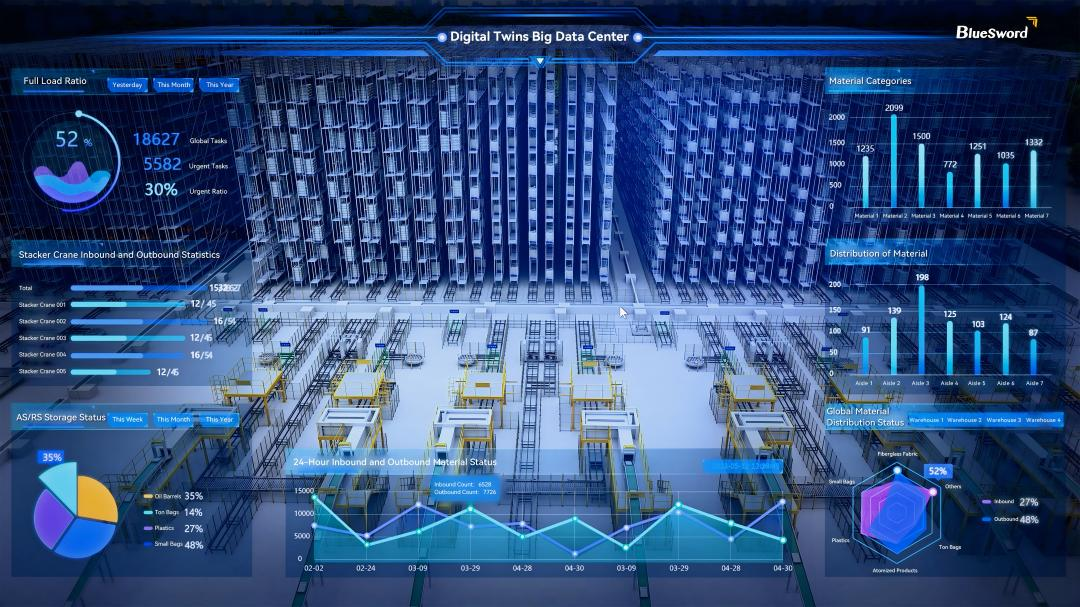
As e-commerce and intelligent manufacturing operations become more complex, warehouse operators need better ways to plan automation systems, identify potential bottlenecks, and coordinate material flows. Digital twin technology provides a virtual environment where engineers can evaluate warehouse layouts and automation scenarios before making changes to physical facilities.
Consequently, the concept of the virtual warehouse has emerged as a transformative strategy for modern distribution centers seeking peak efficiency. By creating a digital representation of the physical intralogistics environment, operators can use virtual simulations to evaluate warehouse layouts, equipment interactions, and different operating scenarios before implementation.
Implementing robust logistics software solutions empowers engineers to map every single conveyor belt, robotic shuttle, and high-density storage rack dynamically. Through this comprehensive digital mapping, decision-makers gain the necessary foresight to refine their automation strategies and ensure resilient performance during peak seasonal fluctuations.
Navigating Dynamic Modeling and Virtual Simulation Technologies
At the core of this technological revolution lies the ability to construct highly accurate three-dimensional models of the intended operational environment. Advanced engineering teams rely on digital twins, artificial intelligence, and cloud computing to build fully connected digital worlds that mirror reality.
To maximize the accuracy of these virtual environments, deploying custom logistics software solutions allows system architects to run extensive simulation analysis and emulation before any physical hardware arrives at the facility.
BlueSword also offers the Integrated Material Handling System (IMHS), a digital twin-driven logistics ecosystem that connects warehousing, sorting, distribution, and operational analytics. Its software components support the coordination of warehouse management, equipment control, and other logistics processes.
Beyond basic structural visualization, accurate virtual simulations facilitate rigorous offline debugging protocols. Engineers utilize these platforms to evaluate the intricate routing algorithms of mobile robots and the precision of automated retrieval systems under extreme stress conditions.
During virtual commissioning, engineers can test WMS, WCS, and PLC logic and check software-hardware integration before physical deployment. This allows potential issues to be identified earlier and reduces the need for repeated adjustments during on-site commissioning.
Furthermore, dynamic planning enables stakeholders to visualize traffic congestion points in multi-level deployments, allowing them to optimize rack configurations and aisle dimensions well before actual construction commences.
Establishing Full Perception and Predictive Maintenance Architectures
Once the automated infrastructure transitions from the planning phase into active operation, the virtual warehouse continuously proves its immense value through comprehensive system monitoring. Modern fulfillment requires absolute transparency across every mechanical component to prevent unexpected halts.
By integrating versatile custom logistics software solutions, facility administrators achieve real-time 3D-SCADA online monitoring that tracks the precise location and health of every deployed unit. Advancing this proactive management philosophy, BlueSword incorporates predictive maintenance capabilities and augmented reality features for remote training operations.
They leverage the Internet of Things to gather diagnostic data from hardware sensors, enabling teams to schedule targeted repairs before minor wear escalates into critical failures.
Achieving comprehensive perception heavily depends on the underlying communication infrastructure supporting the modern facility. Traditional wireless networks frequently struggle to manage the massive data volumes generated by hundreds of autonomous robots constantly reporting their status.
To address this connectivity challenge, 5G technology can provide high-speed, low-latency communication and support the transmission of large volumes of operational data. When deployed with suitable network infrastructure, it can help BlueSword connect management platforms with robotic equipment for more efficient data exchange.
Integrated logistics software can provide management teams with greater visibility into inventory status, order flows, and equipment performance through centralized monitoring and operational data analysis.
Seamless Integration Across Enterprise Management Systems
For a virtual warehouse to achieve its maximum operational potential, it cannot exist as an isolated technological island within the broader corporate network. Intelligent automated facilities must continuously exchange real-time inventory data, incoming order volumes, and shipping manifests with overarching corporate platforms.
Digital twin platforms can work alongside warehouse management and control systems to connect virtual models with operational data. BlueSword’s Pro-WMS is designed to integrate with enterprise systems and automation equipment, supporting data exchange across warehouse, order, and production processes.
Enhancing Warehouse Automation Through Digital Twin Technology
The strategic deployment of digital twins and virtual replicas transcends conventional structural rendering; it fundamentally transforms how modern supply chains approach intricate automation planning and long-term risk management.
Digital twins give warehouse planners a way to evaluate system layouts, test equipment coordination, and review operational data within a connected virtual environment. When combined with virtual commissioning, 3D monitoring, and maintenance analysis, these capabilities can support more informed automation decisions throughout a warehouse’s lifecycle.