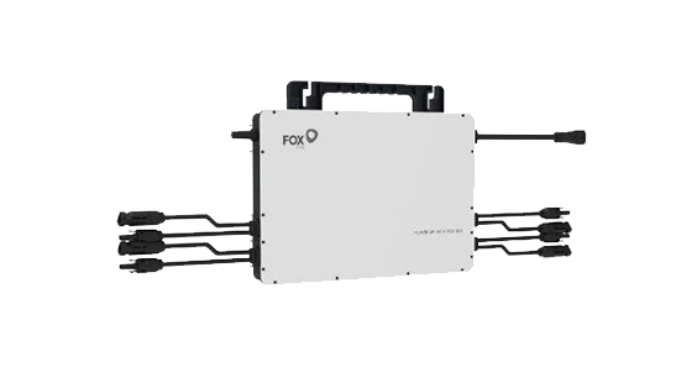
A high-efficiency microinverter is most valuable where the solar array cannot operate under perfectly uniform conditions. Roofs with partial shading, different orientations, restricted installation areas, or changing sunlight throughout the day can create uneven operating conditions between modules. In such systems, conversion efficiency matters, but it works alongside module-level power optimization.
That makes application context more useful than treating efficiency as a standalone specification. The strongest candidates are installations where every module has a meaningful role in overall generation and where operating conditions can change across the array.
Where Conversion Losses Become More Noticeable
Small residential arrays can make energy losses more visible because the available roof area is limited. A modest reduction in conversion performance may represent a larger proportion of the energy that could otherwise be harvested from a constrained installation.
High microinverter efficiency becomes particularly relevant when the system operates for long periods across changing irradiance levels. The objective is not simply to achieve a high number under laboratory conditions, but to minimize unnecessary conversion losses while the array responds to real-world sunlight.
This is why both overall conversion efficiency and Maximum Power Point Tracking (MPPT) efficiency are relevant when comparing microinverters. The Q Series from Fox ESS provides an example, with a published maximum efficiency of 95.5% and MPPT efficiency of 99.8%. The product range covers 1.6–2.4 kW.
Those figures should not be interpreted as a guarantee of a particular annual energy yield. Actual generation depends on the modules, irradiance, temperature, orientation, system design, and other site conditions. They do, however, illustrate why both conversion efficiency and MPPT performance matter when evaluating equipment.
Rooftops with Uneven Solar Conditions
Not every module on a roof receives the same sunlight. Chimneys, nearby buildings, trees, parapets, and roof geometry can introduce partial shading at different times of day. Different roof faces can also experience different irradiance patterns.
Such conditions make module-level optimization particularly useful. Instead of allowing a poorly performing module to influence a larger string, a microinverter architecture can manage individual modules independently.
The Q Series uses independent MPPT control for each PV module and monitors its own status, according to its published datasheet. That architecture is relevant to residential rooftops where shading patterns cannot easily be eliminated through physical redesign.
For installers, high microinverter efficiency can be especially useful on roofs where maximizing usable generation is important. The microinverter still needs to be correctly matched to the PV modules and electrical design, as efficiency cannot compensate for incorrect system sizing.
Systems That Need Flexible Module-Level Design
Compact or architecturally complex rooftops can create another application for efficient module-level conversion. A large central inverter may work well when modules can be arranged in consistent strings, but smaller installations may contain several roof sections with different orientations or available module counts.
Microinverters can provide greater flexibility because conversion occurs closer to the individual modules. The Q Series is designed for module-level MPPT and has a published operating voltage range of 23.5–60V, with a maximum DC voltage of 60V. Its manual lists a recommended PV module power range of 365–700Wp.
Consequently, installers can assess each module and its electrical characteristics rather than treating the entire roof as one uniform generation block. The appropriate application remains dependent on the actual module specifications and system design.
This configuration can be particularly useful for residential projects where roof space is fragmented and system expansion or layout flexibility has practical value.
Installations Exposed to Outdoor Conditions
Efficiency alone does not determine whether equipment is suitable for a rooftop. A device installed beneath PV modules must also be designed for exposure to outdoor environmental conditions.
The Q Series carries an IP67 rating, and the manufacturer describes it as suitable for outdoor installation. That characteristic broadens the relevance of efficient microinverter technology to rooftop environments where equipment must operate outside rather than inside a protected inverter room.
The combination matters because energy conversion performance has limited practical value if equipment selection does not account for the installation environment. Electrical specifications, module compatibility, mounting conditions, and local installation requirements still need to be checked before deployment.
Fox ESS positions its Q Series around low start-up voltage and a wide voltage range as well as efficiency, reflecting an effort to address changing operating conditions rather than focusing on a single headline number.
Why Monitoring Completes the Efficiency Picture
An efficient system still needs visibility after commissioning. Without monitoring, installers and system owners have less information with which to identify underperforming modules or investigate changes in generation.
That makes remote monitoring especially relevant to module-level systems. The Q Series supports monitoring through a smartphone app or web portal, with FoxCloud 2.0 identified for advanced system monitoring in its datasheet.
Module-level visibility can be valuable on complex residential roofs because performance issues may be localized rather than affecting the whole array. Monitoring can therefore complement microinverter efficiency by helping operators understand how the system is actually performing after installation.
For homeowners, this creates a clearer connection between equipment performance and daily solar generation. For installers, it can provide useful information when assessing system behavior remotely.
Evaluating Microinverter Performance as a Complete System
The strongest applications for efficient microinverters are consequently not defined by efficiency alone. Rooftops with partial shading, irregular layouts, limited space, and outdoor exposure can benefit when high conversion performance is combined with independent MPPT, suitable electrical operating ranges, and remote monitoring.
Fox ESS‘s Q Series brings these characteristics together in a module-level architecture. Its design supports project configurations where site constraints make efficient energy conversion and flexible system design important. High microinverter efficiency can therefore contribute to a broader strategy for maximizing usable energy from challenging rooftop conditions.