Custom apparel businesses are under growing pressure to handle diverse designs, shorter production runs, and faster order turnaround. While screen printing remains a practical solution for high-volume orders with relatively simple artwork, direct-to-garment printing offers a different production model. A commercial DTG machine can print detailed, multicolor artwork directly onto garments without requiring physical screens for each design. For businesses focused on customization and on-demand production, this flexibility can become an important competitive advantage.
DTG and Screen Printing Serve Different Production Needs
Screen printing and DTG are not interchangeable technologies. Screen printing uses separate screens for individual colors and requires setup before production. This makes it particularly attractive when the same design is printed repeatedly in large quantities because setup costs can be distributed across many garments.
DTG printing uses digital files and specialized inkjet technology to apply ink directly to the garment. The digital workflow makes design changes considerably simpler, which is valuable for businesses handling one-off products, samples, short runs, and frequently changing artwork. The DTG is particularly suitable for detailed, photographic, and multicolor designs, while screen printing remains highly competitive for larger runs with simpler graphics.
Why a Commercial DTG Machine Fits On-Demand Apparel
On-demand apparel businesses need production equipment that can respond to individual orders without creating excessive setup work. A customer may request a completely different graphic from the previous order, making traditional screen preparation inefficient for small quantities.
A commercial DTG machine changes that workflow by allowing operators to move between digital designs with minimal physical setup. This is useful for customized t-shirts, personalized merchandise, limited collections, samples, and small-scale garment production. Businesses can produce only what has been ordered instead of committing resources to large batches before demand is confirmed.
The approach can also support businesses testing new designs. Instead of producing hundreds of garments to evaluate a concept, an operator can produce a smaller quantity and use actual customer response to determine whether additional production is justified.
Detailed Artwork Can Give DTG an Advantage
Artwork complexity is one of the most important differences between DTG and screen printing. Screen printing can produce strong, bold graphics, but adding colors generally involves additional screens and preparation. Complex gradients, photographic imagery, and highly detailed artwork therefore require more specialized production planning.
DTG technology is naturally suited to digital artwork containing numerous colors, fine details, gradients, and photographic elements. Because the design is processed digitally, changing the artwork does not require preparing a new physical screen. This gives custom apparel companies greater freedom to offer personalized graphics and visually complex products.
For businesses whose customers expect individualized products, this flexibility can be more commercially relevant than simply comparing the theoretical cost per shirt.
Dual Stations Can Improve Commercial Workflow
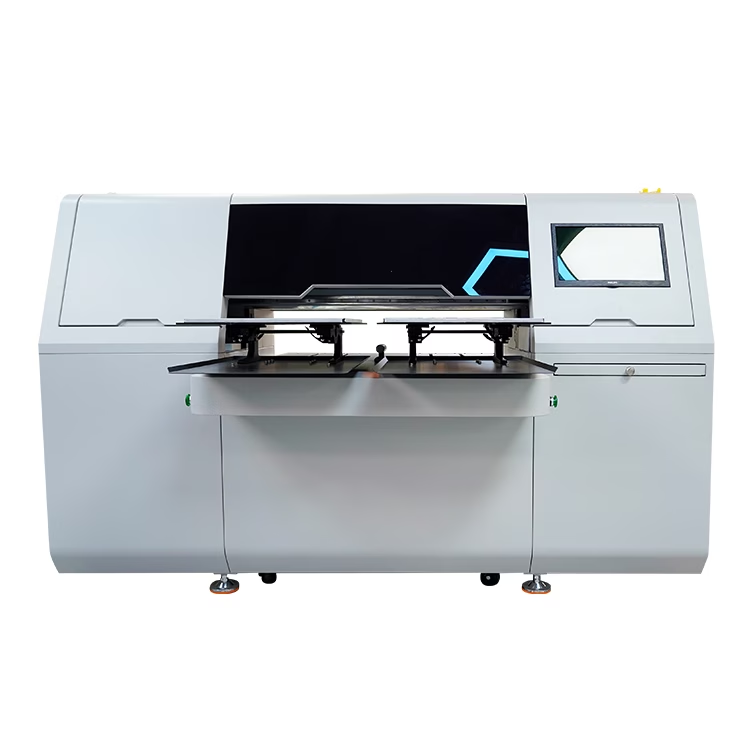
The equipment configuration becomes especially important when a business moves from occasional printing toward regular commercial production. The Xinflying XF-DTG-20 I3200 A1 Double Station DTG Printer is designed around a dual-station workflow, allowing apparel production to be organized around two printing positions.
The XF-DTG-20 has a 40 × 50 cm printing area and uses four Epson i3200-A1 printheads. The listed productivity specifications are 4-pass: 720 × 1200 and 6-pass: 720 × 1800, while the machine dimensions are L2153 × W1236 × H1406 mm.
These specifications make the machine relevant to businesses seeking to move beyond entry-level garment printing. Its dual-station design is particularly suited to operations that need a more organized workflow for repeated t-shirt orders.
Integrated Pre-Treatment Can Reduce Production Steps
Pre-treatment is an important part of DTG production, particularly when printing on garments that require a foundation for the ink. Traditional workflows may involve separate equipment or manual handling, adding another stage that operators need to control.
The XF-DTG-20 combines automatic pre-treatment with high-resolution DTG printing in one compact production solutio. This integration can simplify the production sequence by bringing key preparation and printing processes closer together.
For business apparel operations, fewer disconnected production stages can make workflow management easier. It can also help businesses establish a more consistent process across repeated orders, provided that operators follow appropriate garment preparation and curing procedures.
Xinflying’s DTG Portfolio Supports Different Business Scales
The choice of equipment should also be evaluated in relation to the Xinflying DTG printer manufacturer and its broader product portfolio. Xinflying currently lists three DTG printer models, including the XF-DTG-10 I3200 A1 T-Shirt DTG Printer and the XF-DTG-20 I3200 A1 Double Station DTG Printer.
Xinflying describes itself as a digital printing equipment manufacturer and supplier covering DTF, UV DTF, DTG, sublimation printing, and related consumables. Its official website also states that the company provides technical assistance and online training for customers.
For commercial buyers, this broader capability can be relevant when evaluating equipment suppliers. A manufacturer with multiple digital printing technologies may offer businesses more options as their product categories and production requirements develop.
Choosing Between DTG and Screen Printing by Business Model
The most suitable technology depends on order volume, artwork complexity, garment requirements, and customer expectations. Screen printing can remain a strong choice for large quantities of the same design, particularly when graphics use relatively few colors. Its setup requirements become easier to justify as production volume increases.
DTG is more compelling when order quantities are smaller, artwork changes frequently, or customers demand highly detailed and colorful designs. It is particularly compatible with print-on-demand models because each garment can be produced from a digital file without creating a new screen for every design.
Businesses should therefore avoid treating DTG as a universal replacement for screen printing. Instead, the technology should be evaluated according to the commercial model it needs to support.
A Practical Step Toward More Flexible Apparel Production
For custom apparel businesses, the central question is not simply whether DTG is better than screen printing. The more useful question is which technology best matches the company’s order profile and growth strategy.
A commercial DTG machine can provide meaningful advantages when businesses need detailed graphics, frequent design changes, personalized orders, and flexible production quantities. The Xinflying XF-DTG-20 further combines a dual-station configuration, four Epson i3200-A1 printheads, a 40 × 50 cm printing area, and integrated automatic pre-treatment to support a more streamlined garment-printing workflow.
For companies moving toward on-demand apparel production, these capabilities can provide a practical alternative to screen-printing workflows built around large, repeated orders. By comparing production volume, artwork complexity, workflow requirements, and equipment specifications, buyers can determine whether Xinflying’s DTG solutions provide the right foundation for expanding commercial garment customization.