For engineers developing elastomer components, the manufacturing question is often less about whether silicone can meet the application and more about how the material should be formed without creating unnecessary tooling or process complexity. Silicone compression molding addresses that decision by shaping a measured charge of uncured silicone directly inside a heated mold, then curing it under controlled heat and pressure. The method is especially relevant when geometry, production quantity, wall thickness, and tooling economics point away from highly automated routes.
The process begins before a press closes. A manufacturability review establishes the parting line, cavity geometry, vents, flash-control features, and material requirements. HordRT approaches this stage as an engineering exercise rather than simply a tooling order, because decisions made in the mold design can influence trimming, demolding, dimensional consistency, and production stability later.
Material Preparation Sets the Starting Point
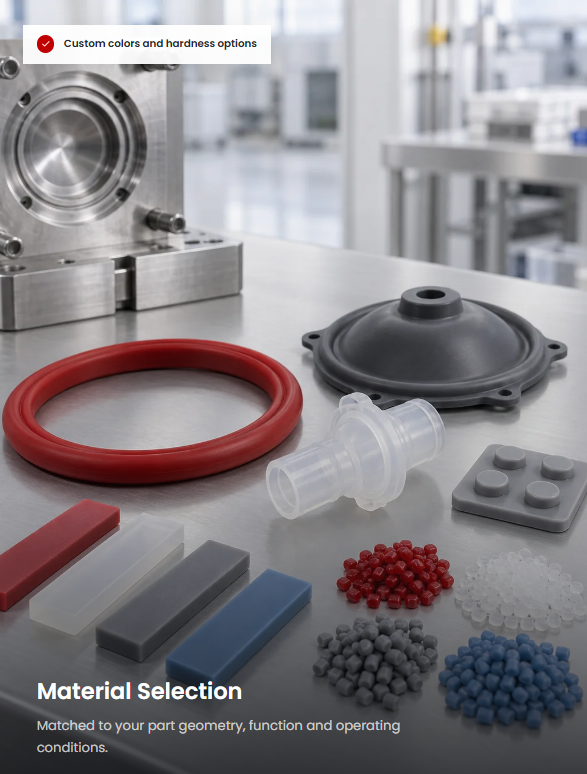
High-consistency rubber (HCR) is commonly used for compression molding. Unlike liquid silicone rubber, HCR arrives as a solid, gum-like compound that can be weighed and prepared into a charge before molding. Charge quantity matters: too little can contribute to incomplete filling, while excess can increase flash and trimming.
Material selection also has to follow the part’s operating environment. Hardness, cure system, temperature exposure, chemical contact, color, and any application-specific compliance requirements should be defined before tooling is finalized. Platinum-cured and peroxide-cured systems, for example, can have different processing and post-curing considerations, so the material specification should not be treated as an afterthought.
The Mold Determines How the Charge Becomes a Part
A compression mold normally consists of mating cavity surfaces that close around the prepared silicone. Once the charge is positioned, the heated mold closes and pressure spreads the material through the cavity. Heat then drives vulcanization, converting the uncured compound into a stable elastomer.
Parting-line placement matters because the process naturally produces some excess material at the mold interface. A deliberate flash-control strategy can make that excess easier to remove and keep the parting line away from sealing or cosmetic surfaces. Venting is equally significant: trapped air can produce voids or surface defects if it cannot escape as the cavity fills.
Geometry should be developed around the behavior of cured silicone rather than rigid thermoplastics. Flexible silicone can often tolerate limited forced demolding and certain undercuts that would complicate a rigid-plastic mold. Deep cavities, sharp transitions, abrupt wall changes, and demanding cosmetic surfaces still require careful review because they can increase tearing, air entrapment, or inconsistent curing.
Curing Is a Controlled Transformation, Not Simply a Heating Step
Once the mold closes, temperature, pressure, and time interact to determine whether the material cross-links adequately. Cure conditions depend on the compound, section thickness, mold design, and production setup. A thicker region generally takes longer to cure than a thin section, making large variations in wall thickness a potential source of uneven vulcanization.
HordRT’s design guidance provides general recommendations for silicone wall thickness, while noting that thicker sections may require additional attention to curing. These recommendations should be treated as design guidelines rather than universal specifications; the actual material formulation and component geometry remain decisive factors in determining the appropriate wall thickness.
Dimensional planning also needs to account for silicone shrinkage after curing. Mold compensation should therefore be based on the selected compound and validated through sampling rather than copied from a generic shrinkage assumption. For tighter dimensional requirements, mold accuracy, process repeatability, inspection frequency, and material behavior all become increasingly important.
Troubleshooting Starts With the Defect Mechanism
Flash, incomplete filling, air traps, and edge damage rarely have a single universal cause. Excessive flash can result from charge quantity, mold condition, or insufficient clamping, while short fill may reflect material placement, charge weight, geometry, or processing conditions. Treating every defect as a temperature problem can therefore send troubleshooting in the wrong direction.
Air-related defects call for attention to vent locations and cavity filling behavior. Complex parts may benefit from vacuum assistance where appropriate. Edge tearing can also indicate that the material near the parting line has not reached sufficient cure before mold opening. Corrective action should follow the physical mechanism rather than rely on a fixed parameter change.
Where the Process Fits the Sourcing Decision
Silicone compression molding is particularly relevant for low- to mid-volume production, larger or thicker silicone components, and projects where simpler tooling is commercially attractive. It does not automatically replace silicone injection molding. Automated LSR injection can be more appropriate when high-volume production, repeatable metering, and complex automated processing justify its tooling and equipment requirements.
The selection therefore starts with the part, not the machine. A sourcing team should compare volume, geometry, material form, tolerances, cosmetic expectations, tooling budget, cycle economics, and post-molding labor. HordRT can use those inputs to determine whether compression molding is technically and commercially aligned with the project.
The practical question is whether its tooling model matches the part being developed. A sound project connects the silicone formulation, charge design, cavity geometry, venting, flash strategy, curing conditions, and inspection plan before production begins. That integrated view reduces the risk of solving a molding defect after tooling has already locked in the underlying cause.
For engineering and procurement teams, the strongest starting point is a complete part definition paired with production requirements. From there, a supplier can evaluate manufacturability, identify sensitive features, and establish a process window that supports repeatable silicone parts rather than relying on generic molding assumptions.